The Name He Outbuilt
How John D. Rockefeller let the record close without him—and how his son rebuilt it.
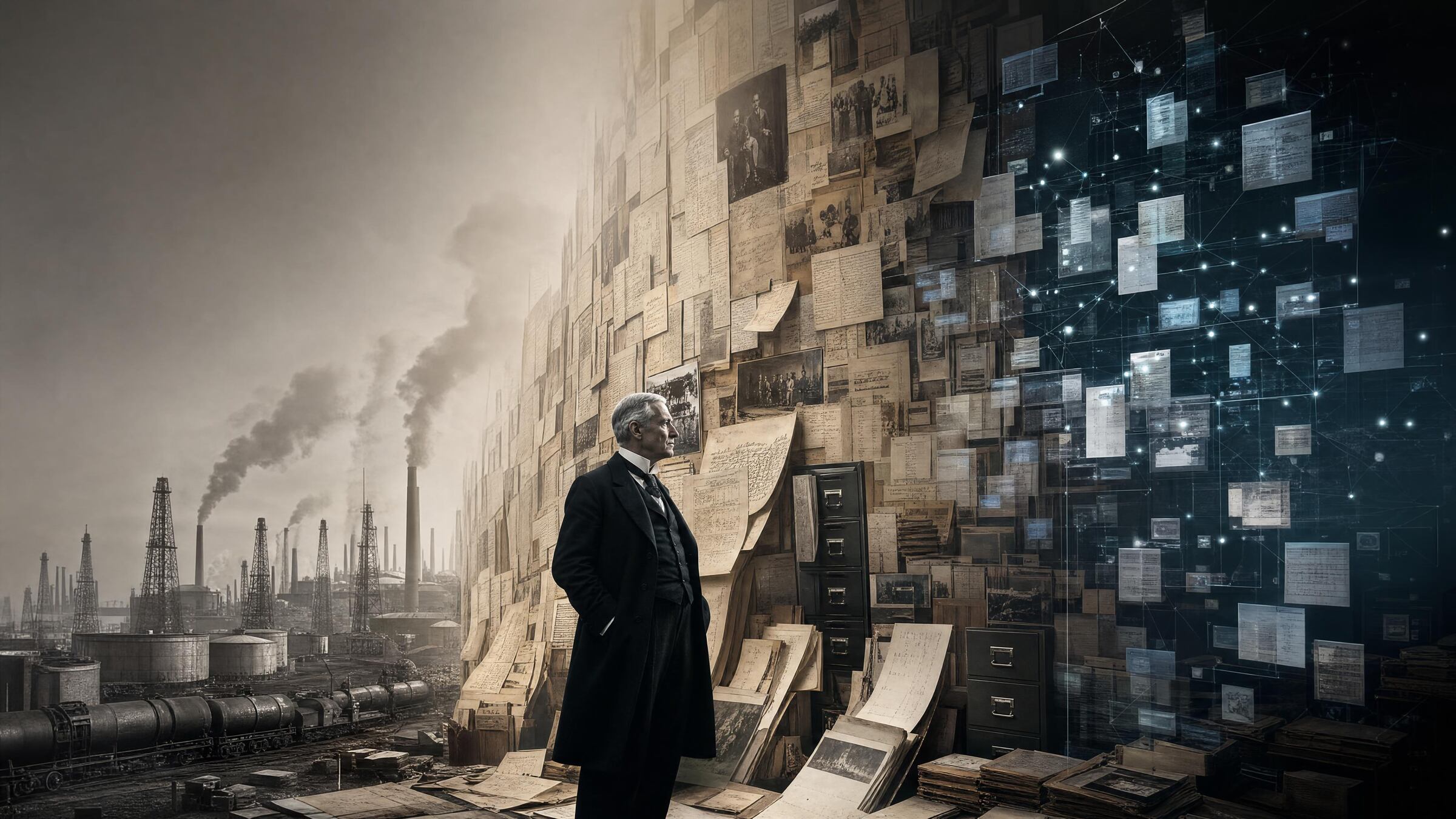
At the start of the 20th century, there was no company more rich, more powerful, and more dominant over the American economy than Standard Oil. John D. Rockefeller patiently built an empire over decades that monopolized 90% of the country’s oil refining, only to see the public account of what he built tarnished by the pen of journalist Ida Tarbell, who grew up in the Pennsylvania Oil Region where her father’s independent oil production business was damaged by Rockefeller’s vertical integration. Between 1902 and 1904, she published a 19-part series exposé detailing Rockefeller’s efficient but ruthless business tactics that deprived many in the oil industry of their livelihoods. Her work was scrupulous, impeccably documented, and reputationally disastrous for Rockefeller.
Despite his influence to shape narratives in the press, Rockefeller’s policy was to say nothing amidst the ongoing exposé. His silence was not neutral. It was quiet confirmation of the allegations that Tarbell disclosed through public court records, testimony, and documents. He did not lose the argument. Rather, by declining to enter it, the record closed without him on a punishing verdict. By the time his own account of events came out in 1909 titled Random Reminiscences of Men and Events, Standard Oil was already in litigation with the Federal government, and by 1911 the Supreme Court disbanded Standard Oil on account of violating the Sherman Antitrust Act.
The Best-Sourced Version Wins
Rockefeller remains one of the most diligent and competent businessmen of all time. He sent messages in code so that only the intended receiver could decipher and be privy to company decisions. He kept extremely detailed accounting records, managing his cost to the penny. He knew the details of his business better than anyone living at the time, and yet the account that the public came to learn about his company was written by an adversary he never expected. Ida Tarbell was not a rival business tycoon whose business he could topple or absorb into his expanding empire. She was an established magazine writer and editor at McClure’s working from documents and testimony, and her interpretation of the facts stood alone as the canonical account.
A vacuum around such a consequential name as Rockefeller’s gets filled by whoever is willing to do the documentary work. Tarbell’s advantage was not hostility, but sourcing. Rockefeller’s decision to not engage in any public rebuttal of her allegations was a critical mistake. He was not a third-party observer that could remain neutral. The absence of an organized public record of Standard Oil made it ripe for the taking, and Tarbell’s account was the best-sourced version. And it won.
Nineteen Bulletins
Whatever lessons were learned from permitting absence to create a void around Rockefeller’s reputation, new mistakes were made when a professional communications operation tried to hide damaging information from the public. On April 20, 1914 at the Rockefeller-controlled Colorado Fuel and Iron Company, the conflict between capital and labor spilled over in a deadly confrontation known as the Ludlow Massacre. Nearly two dozen people died, including two women and eleven children who suffocated in a pit beneath a burning tent. The public was rightfully outraged.
Ivy Lee, the pioneering American publicity expert and one of the founders of modern public relations, was tasked with responding publicly on behalf of the Rockefeller Family. He published a series of nineteen bulletins titled The Struggle in Colorado for Industrial Freedom. They were a PR disaster. One attributed the fire to a stove the women and children had overturned in flight. Another reported a conference of Colorado editors supporting the company without disclosing that just fourteen of the state’s 331 editors attended, and only eleven signed. The bulletins were printed in Philadelphia and shipped to Denver for mailing from CF&I headquarters, suggesting they were produced in-house. His critic, Upton Sinclair, labeled him “Poison Ivy.”
Two errors doomed Lee’s nineteen bulletins before the ink even finished drying. Every claim that hurt him was a claim that could be checked. A hostile reader could snuff out an over-inflated claim, a carefully worded hedge that avoided the reader’s core concern, and alleged facts that were proven to contain little white lies. These falsehoods confirmed the suspicion that the information, and the sources behind it, were not credible. Lee’s folly was assuming that the audience would not check.
Secondly, the source of truth for these nineteen bulletins stemmed from the Committee of Coal Mine Managers, not from third-party investigative sources or input from the labor union. The bias was obvious, and the press tore it apart like vultures on carrion. Instead of acknowledging the concerns of miners looking to unionize; namely, better working conditions, better wages, better enforcement of the eight-hour workday, the bulletins functioned as a defense of mining management and provided a public platform for their grievances.
From Saying to Showing
The fallout from the Ludlow Massacre created an uphill reputational battle to restore and preserve the legacy of the Rockefeller name. That work fell to a different man. John D. Rockefeller Sr. had let the record close without him. His son inherited the company, the fortune, and the verdict, and he answered it differently.
In 1915, John D. Rockefeller Jr. was called before the federal Commission on Industrial Relations and questioned about the strike, the evictions, and the deaths. He answered under oath, into a record he did not control, could not edit, and could not withhold. Rather than putting out statements from the company, Rockefeller Jr. went to Colorado and spent two weeks in the coal camps hearing the miners’ grievances in person, visiting their working conditions inside the mines, and breaking bread with their families inside their homes. In October of that year the company put forward an employee representation plan developed with William Lyon Mackenzie King, the Canadian labor expert the family had retained. Critics called it a company union built to keep the United Mine Workers out, and that criticism has held up for a century. But the plan's merits are not the point. The conduct was observable, and the reporting shifted to third-party observers that provided a more neutral record.
Critically, the Rockefeller family transitioned from crisis management to reputation architecture that no press office could manufacture. Rockefeller Senior’s philanthropic initiatives included the campaign to eliminate hookworm disease in the American South, providing the funding to start the University of Chicago, and creating the Rockefeller Institute for medical research. His son continued that tradition by donating the land that would become the headquarters for the United Nations, further supporting a record that would govern the historical reading on the family’s achievements.
Then the move that matters most: the family kept the primary record. The American historian Allan Nevins wrote John D. Rockefeller: The Heroic Age of American Enterprise from family papers in 1940 and then produced a follow-up biography Study in Power: John D. Rockefeller, Industrialist and Philanthropist in 1953. Rockefeller Junior’s children also established The Rockefeller Archive Center in 1974. It opened to researchers in 1975 and to this day historians continue to work there. Tarbell’s exposé was a seminal achievement in investigative journalism that historians continue to cite. Both records survived, and only one of them was built on purpose.
Ivy Lee did not fare as well. In 1933 he took a retainer from IG Farben, the German chemical conglomerate that had become a major contractor to the new Nazi government. He testified before the McCormack-Dickstein committee in July 1934, admitted meeting Goebbels, the Minister of Propaganda for Nazi Germany, and died that November. His firm dissolved the following year, and the man who rebuilt the Rockefeller name left his own defined by a single damaging engagement.
The Assembly Is Now Automatic
Ida Tarbell spent two years assembling documents into a verdict on one man. Retrieval systems now perform that assembly in seconds, for anyone whose name is typed into them, using whatever record exists at the moment of search. Picture it like your name is plastered on a billboard bolted to buoys. The sea it floats on is the internet, and it never stops moving. The billboard is accurate but shifting seas make it difficult to read.
From my own forthcoming study on how AI describes Philippine business leaders, source availability and repetition can sometimes overpower recency or authority. This causes embarrassing errors. A stale title carried by enough pages outvotes a current one. An adverse fact absent from the indexed record is absent from the AI-generated answer. So the people who look best are not the people with the best conduct. They are the people with the most legible record. Today there is no two-year delay while an Ida Tarbell assembles that record. The verdict gets refreshed and assembled uniquely each time someone searches your name.
Delivered by email. Nothing else.