From The Machine's Version, published October 2026.
For people who are about to be researched
The Program is for founders, principals, and executives whose names come up before an important decision. It fits best at one of these moments:
- Before a fundraise
- Before a sale or recapitalization
- After a new appointment
- Before significant media coverage
- Before entering a new market
If someone will decide about you this year, they will search your name first.
The Research Surface Score
I ask the questions a counterparty asks before a deal. I put each one to ChatGPT with web search, Gemini, and Perplexity. I score every answer against a record I verify first from primary sources.
Each answer is scored on five dimensions, from 0 to 3.
- Accuracy
- Is what it says true?
- Currency
- Does it describe your role today, or a role you held before?
- Definition
- Does it describe you, someone else with your name, or no one at all?
- Source quality
- What does the answer rest on?
- Tone
- Does the answer's verdict match the evidence behind it?
Six questions, three tools, and five dimensions give a maximum of 270. Your total is your Research Surface Score. The study used the same scale for its three search-enabled tools. The study also tested ChatGPT with web search turned off. The Program leaves that test out, because people who research you use tools that search the web.
What the review diagnoses
The score shows how far the answers sit from the truth. The diagnosis shows why.
In The Machine's Version, I classified every failure by mode. There are eight. Each mode has a different cause, and a different party who can fix it.
| Mode | What it means | Who can fix it |
|---|---|---|
| Absence | The machine has almost nothing under your name. | Your record. New sources fix it. |
| Legacy | The machine describes a role or company you have left. | Your record. The stale pages can be updated or corrected. |
| Collision | The machine delivers another person's record under your name. | Your record, when a real namesake exists. Clear identifiers separate you. |
| Damage | The machine finds real adverse material that names you. | Assessed separately. See the FAQ. |
| Fragmentation | The machine assembles several partial versions of you. | Your record. One canonical profile joins them. |
| Contradiction | Two answers about you cannot both be true. | Your record, when the conflict comes from your own sources. |
| Authority Deficit | The answer rests on sources a careful reader would not accept. | Your record. Authoritative sources replace weak ones. |
| Machine Distortion | The machine states something no record contains. | The machine. Monthly monitoring catches it, and a fuller record leaves less room for it. |
Mode
Absence
What it means
The machine has almost nothing under your name.
Who can fix it
Your record. New sources fix it.
Mode
Legacy
What it means
The machine describes a role or company you have left.
Who can fix it
Your record. The stale pages can be updated or corrected.
Mode
Collision
What it means
The machine delivers another person's record under your name.
Who can fix it
Your record, when a real namesake exists. Clear identifiers separate you.
Mode
Damage
What it means
The machine finds real adverse material that names you.
Who can fix it
Assessed separately. See the FAQ.
Mode
Fragmentation
What it means
The machine assembles several partial versions of you.
Who can fix it
Your record. One canonical profile joins them.
Mode
Contradiction
What it means
Two answers about you cannot both be true.
Who can fix it
Your record, when the conflict comes from your own sources.
Mode
Authority Deficit
What it means
The answer rests on sources a careful reader would not accept.
Who can fix it
Your record. Authoritative sources replace weak ones.
Mode
Machine Distortion
What it means
The machine states something no record contains.
Who can fix it
The machine. Monthly monitoring catches it, and a fuller record leaves less room for it.
In the study, 73% of failures began in the public record. That is the share you can act on.
What my own results showed
I asked the same question about my own name, once in August 2026 and again in November 2026, with the same settings both times.
Google, November 2026
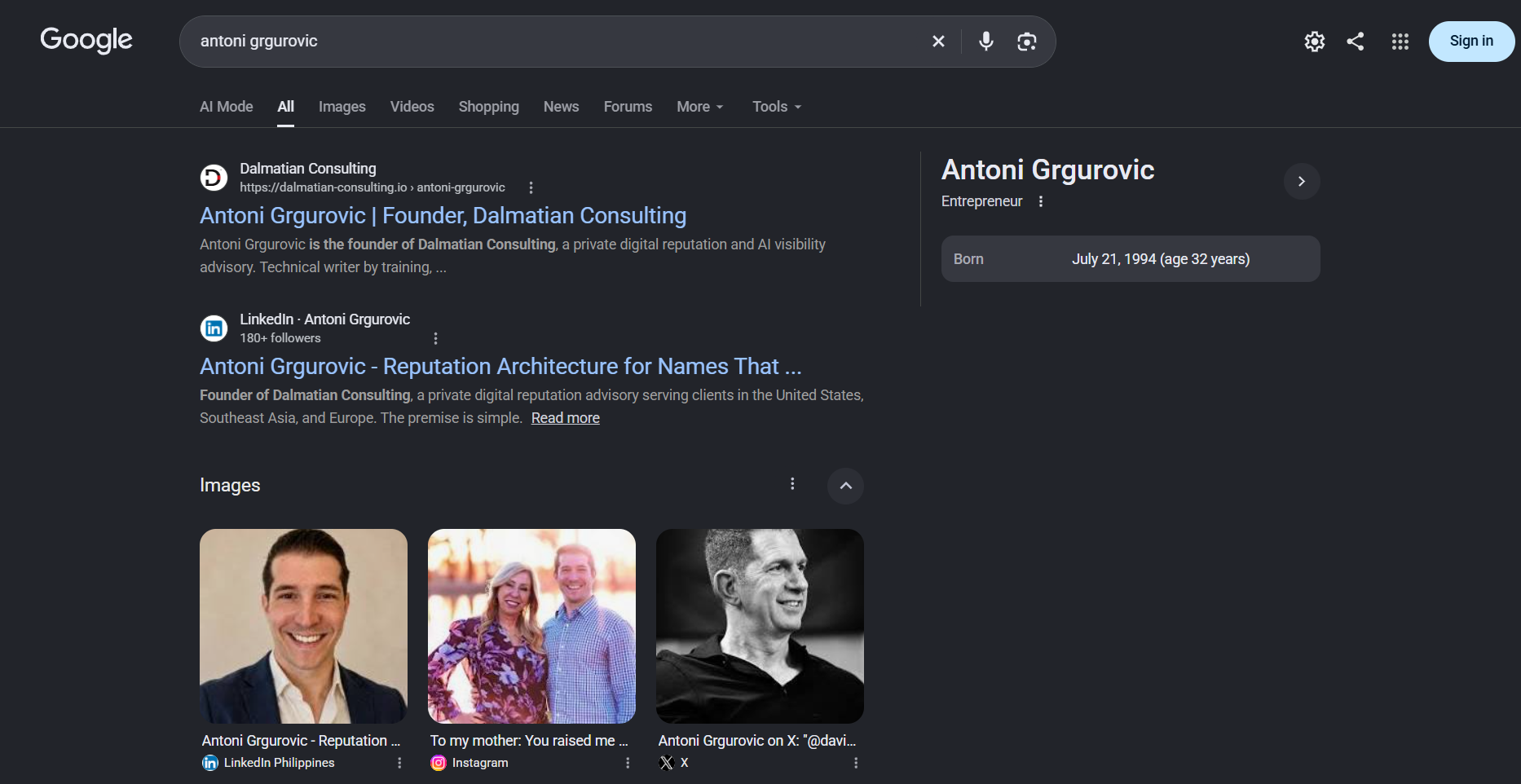
Chrome Signed Out (Incognito) Chicago, IL, USA, November 2026.
Google identifies me correctly, with a Knowledge Panel.
ChatGPT
Perplexity
August 2026
It cited ten sources and still found no verifiable entry.
November 2026
It found the record and identified me correctly.
Gemini
August 2026
It gave the most confident answer. It also stated a personal detail that is false.
Claude
Google, ChatGPT, Perplexity, and Gemini now identify me correctly. Claude searched the web and still did not. The record was the same for all five. A record can be correct and a tool can still miss it. That's why I measure every tool separately.
The Research Surface Score uses ChatGPT with web search, Gemini, and Perplexity. Google and Claude are shown for comparison.
How the Program runs
- 01
Week 1
Private Exposure Review
I verify your record from primary sources. Then I run the baseline: the counterparty questions across three AI tools, plus your first page of Google results. You receive a scored report, a diagnosis of which failure modes are present, and a map of every source the answers rest on.
- 02
Weeks 2 to 6
Authority Foundation
We hold one 60- to 90-minute interview. From it, I write your canonical profile and a set of bios. I align the sites and profiles you control, add structured data, and send correction requests where a third party carries an error.
- 03
Monthly, from week 7
Credible Narrative Development
I write long-form pieces from your own material. Each piece adds a source that describes you correctly.
One piece runs as a paid placement in an outside publication, labeled as the publication requires.
I also pitch editors whose own writers could cover you. A feature written by a publication's own columnist carries more weight than anything you publish or pay for. Editors decide what they publish, so I cannot promise a feature. I pitch 5 publications every month as part of the work.
- 04
Monthly, from week 7
Ongoing Reputation Protection
I re-run the questions every month and report the score. When a major AI model or AI search feature launches, I re-run your baseline within 72 hours and report what changed. I maintain the record and tell you when something changes. At day 90, you receive a full re-score with before-and-after captures.
What it asks of you
One 60- to 90-minute interview. Fifteen minutes a week to review drafts. Everything else arrives in writing, so you can read it on your own schedule. Calls happen when you want them.
What you receive
- A scored baseline report
- A failure-mode diagnosis, with who can fix each mode
- A map of the sources behind every answer
- A canonical profile and a set of bios
- Changes to the sites and profiles you control, with structured data
- Correction requests to third-party sources
- Long-form pieces written from your own material, and one paid outside placement
- Monthly pitches to editors for independent coverage
- A monthly score report
- A re-run within 72 hours of every major AI model or AI search launch
- A day-90 re-score with before-and-after captures
Investment
Review and Foundation
From $7,500
Phases 1 and 2. Fixed fee, half at the start and half on delivery.
Narrative and Protection
$2,500 a month
Phases 3 and 4. Three-month minimum, starting in week 7.
The minimum engagement is Phases 1 and 2 plus three months of Phases 3 and 4.
Prices are in US dollars. European clients can pay in euros. A record that spans several companies, names, or markets is scoped in the proposal before any work begins. Adverse material remediation is assessed separately through a Private Review submission.
What I control, and what I do not
I control the sites and profiles you own, the writing, and the correction requests.
I do not control Google's rankings, third-party publishers, or how AI tools weigh their sources.
The score reports what changed. It does not promise a number.
FAQ
Can you remove something negative about me?
Some errors and false statements can be corrected or removed. Court records and lawful reporting stay where they are. If adverse material that names you is part of your record, the review reports it under Damage, and we decide together whether it belongs in this Program or a separate engagement.
How much of my time does this take?
One 60- to 90-minute interview, then fifteen minutes a week to review drafts.
Where do you work?
I work from Manila and Zadar, serving North America, Southeast Asia, and Europe. The work runs asynchronously and in writing, so time zones don't slow things down.
Why not use an AI visibility tool instead?
A tool can tell you what AI says about you. It checks those answers against what is already online, and that is where most errors begin. In The Machine's Version, 73% of failures began in the public record. I verify your record from primary sources, decide which errors matter to the people who will research you, and fix them. The score is the evidence. The verification and the fixes are the work.
Will anyone know I am a client?
No. I do not publish client names, logos, or identifiable case studies.
What happens after I apply?
I read every application myself and respond within 24 hours. If the Program fits, I send a short written read of what I found before we speak. Then we hold one 30-minute call, and I send a fixed proposal.
I respond within 24 hours.
Apply for a Private Review