The Space Between Light and Memory
The gold leaf shifts as you move past a Michelle Sakhai painting. The work cannot be fully experienced in a photograph, which in an era of Instagram collecting is a decision.
Antoni Grgurovic ·
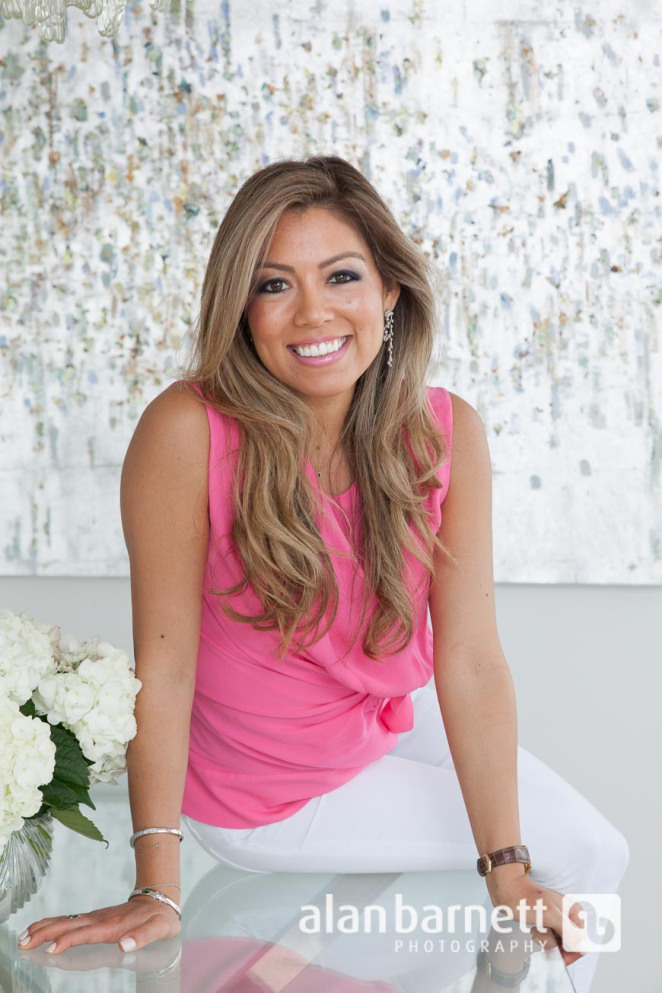
Look closely at one of Michelle Sakhai's paintings and something happens that doesn't quite have a name. The gold and silver leaf shift as you move, not dramatically, but enough to make you wonder if the surface is breathing. It's a trick of physics, but it feels like something else. That ambiguity is the point.
Sakhai grew up between two cultures that both understand this — the Persian tradition of art as spiritual practice, the Japanese tradition of craft as devotion. Neither heritage treats beauty as superficial. Growing up with both meant she absorbed, early, the idea that a made object could hold meaning the way a vessel holds water: invisibly, completely. It also gave her a visual fluency that doesn't announce itself. Her paintings don't read as "Eastern" or "Western," but rather as something harder to place, which is probably closer to the truth of how she actually experiences the world.
From Landscape to Luminous Abstraction
She started as a landscape painter, working en plein air in high school, learning to read light outdoors before she learned to manufacture it indoors. That foundation matters. Her later pivot to abstraction wasn't a rejection of the natural world but a distillation of it, an attempt to capture not what a landscape looks like but what standing inside one feels like. She completed an MFA and studied abroad, and by the time she emerged, the literal trees and horizons had given way to surfaces that suggested them: layered, luminous, geological in texture.
Building a career around that kind of work is its own discipline. The art world rewards novelty and connection in roughly equal measure, and Sakhai has been deliberate about both. Her solo exhibitions have spanned Seoul, Dallas, and Tokyo, each anchored in themes of inner growth and renewal, each finding audiences who responded to the work not just aesthetically but personally. Collectors at Montefiore Einstein Medical Center in New York and OD Talamanca in Ibiza now live with her paintings in contexts designed for healing and retreat, which feels apt. Her installations at Miraval Wellness Centers and the Fairmont Hotel in San Francisco occupy spaces where people go specifically to slow down. There's a logic to that placement. Her work doesn't compete for attention so much as it gradually earns it, revealing itself over time rather than all at once.
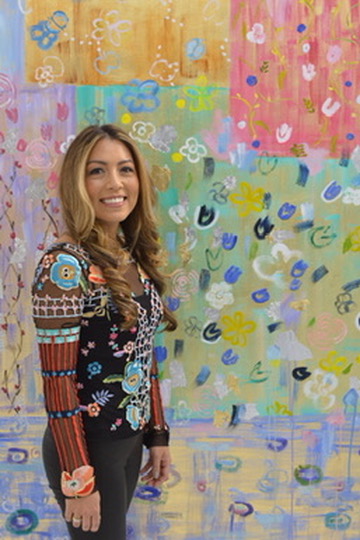
A Distinctive Visual Language Rooted in Heritage
That alignment between the work and its context isn't accidental. Sakhai pays close attention to how art functions in a room, how a surface that catches morning light differently than afternoon light changes the emotional register of a space over the course of a day. The metallic leaf in her paintings isn't decorative in the conventional sense; it's relational. It requires the viewer and the light source and the time of day. It can't be fully experienced in a photograph, which in an era of Instagram-driven collecting is either a liability or a quiet act of resistance.
She would probably say the latter. "When you stay rooted in your vision rather than reacting to the market," she has said, "you don't have to chase what's next. You evolve naturally — and often ahead of it." It's the kind of thing that's easy to say and hard to live by, but her career suggests she means it. The wellness and hospitality world's recent appetite for art that does atmospheric work — that changes how a room feels rather than just how it looks — caught up to where her practice already was. Recognition has followed: grants from the Vermont Studio Center, the Grey Cube Gallery Merit Award, invitations to lecture at Hofstra University and the San Francisco Public Library. These are markers of an artist taken seriously by institutions, not just the market.
What's harder to articulate, and maybe more important, is what happens in the gap between making and looking. Sakhai describes it as feeling another person's energy through their mark-making — a form of contact that doesn't require presence. You can't see the painter. But something got through. The oil and the leaf and the hours of layering become a record of a particular state of attention, and viewers, if they slow down enough, find themselves in conversation with it. Whether you call that spirituality or just the particular alchemy of material and intention, it's the reason people stand in front of certain paintings longer than they planned to.
Sakhai's pieces tend to be those paintings.